Payee Experiences: Why They Matter in Modern Global Payouts
Introduction

If you manage global payouts, your growth depends on more than moving money. It depends on how recipients experience the payment process.
Payee experiences describe the end-to-end journey a recipient has when receiving funds, from onboarding and compliance to payment speed, method choice, transparency, and access to earnings. It’s the payout-side equivalent of customer experience. For operators running marketplaces, affiliate networks, gig platforms, and commission-based businesses, it directly affects retention and performance.
Your payees are not entries in a disbursement file. They are sellers deciding whether to stay active, creators choosing which platform to prioritize, agents placing business, or contractors calculating where they’ll get paid fastest. Often, the payout moment is the only financial interaction they have with your brand.
When payee experiences are slow, fragmented, or opaque, engagement declines and support costs increase. When they are fast, flexible, and predictable, loyalty strengthens. This article examines what defines strong payee experiences and how modern global payouts infrastructure determines whether you can deliver them at scale.
Key Takeaways
- Measure time to first payment to reduce activation delays and early churn.
- Expand global payout methods to increase payee engagement and activity.
- Consolidate payout providers to lower compliance overhead and support volume.
- Align payout experience metrics with retention and revenue targets.
- Implement a payouts orchestration layer to scale global payouts without adding new integrations.
What Are Payee Experiences in Global Payouts?
Payee experiences describe how recipients interact with your payout infrastructure, from initial onboarding through ongoing payment access. Unlike customers, who purchase from your business, payees earn through your platform. They may be affiliates promoting products, marketplace sellers fulfilling orders, insurance agents earning commissions, gig workers completing tasks, or contractors billing for services. Their relationship with your brand is defined by how reliably and efficiently they get paid.
In domestic environments, the payout experience is relatively straightforward. In global payouts, complexity multiplies. Currency conversion, local banking rails, regulatory requirements, identity verification, tax documentation, and payout method availability all vary by country. What feels seamless in one market can become slow or fragmented in another.
Cross-border friction remains a persistent challenge. The World Bank notes that the global average cost of sending remittances remains above 6% of the transaction value, well above international targets. While business payouts differ from remittances, the underlying infrastructure challenges are similar.
At scale, payee experiences are shaped not just by payment speed but also by how well your systems handle global complexity while keeping it hidden from recipients.
Why Payee Experiences Drive Retention and Growth

Strong payee experiences influence behavior. When recipients trust that they will be paid quickly and predictably, they stay active and engaged. When payments are delayed, limited, or opaque, activity slows and churn increases.
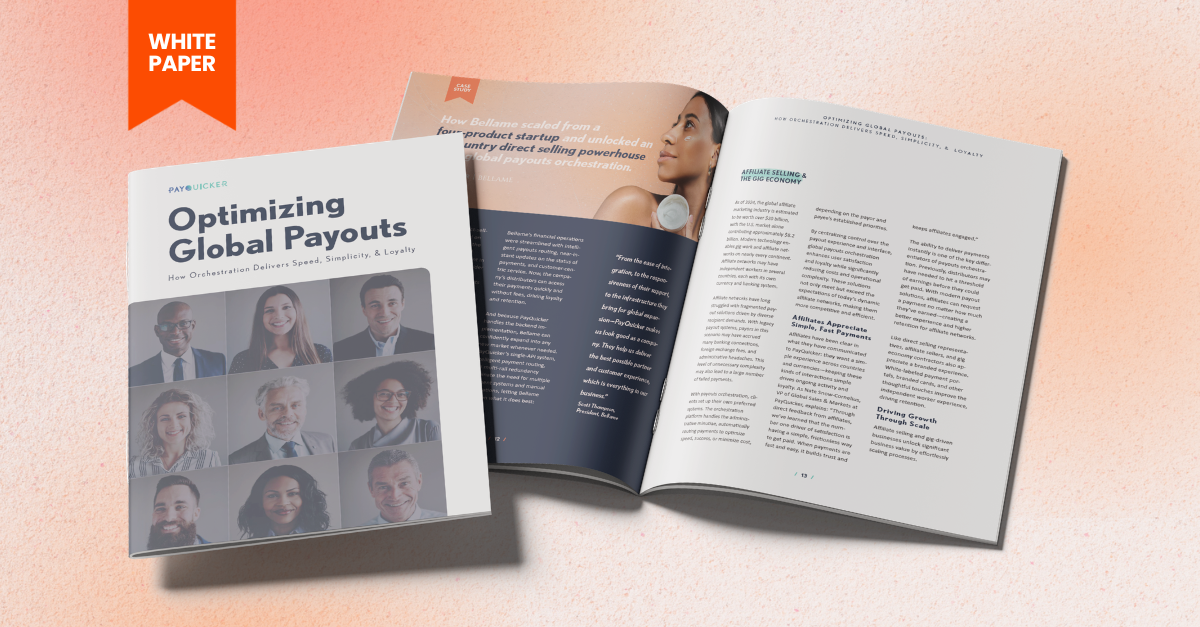
The global payouts landscape is evolving rapidly as platforms compete for independent workers, sellers, and partners. PayQuicker’s recent whitepaper on turning global payouts into a growth strategy highlights how payout speed, flexibility, and reliability increasingly influence where payees choose to participate. As organizations scale globally, recipients compare platforms not only based on opportunity, but also on how quickly and easily they can access their earnings.
The economic impact is direct. Faster payouts improve seller velocity and affiliate promotion intensity. Instant commission access allows a creator to reinvest in advertising or content immediately. A 30-day delay forces them to wait, reducing momentum and sometimes shifting their focus to another network.
Payee retention is rarely driven solely by branding. It is reinforced each time as funds arrive. Platforms that reduce friction in that moment often see higher repeat activity, fewer payout-related support tickets, and stronger long-term loyalty.
Where Payee Experiences Breakdown
Even well-intentioned platforms struggle to deliver a consistent payout experience at scale. Breakdowns typically occur at the infrastructure level.
First, there’s fragmentation. Many organizations rely on multiple providers to support different corridors, currencies, or payout methods. This creates inconsistent processes, uneven timelines, and operational overhead that surfaces as friction for payees.
Second, delayed or batch-based disbursements. While real-time payment rails are expanding, not all systems are designed to leverage them. McKinsey reports that adoption of real-time payments continues to accelerate globally, yet many platforms still operate on legacy settlement cycles. The result is a gap between recipient expectations and payout execution.
Third, limited payout options. Offering only one method, such as domestic bank transfer, ignores regional preferences and restricts access for global payees.
Finally, repeated compliance and identity verification requirements further complicate payee onboarding. When recipients must resubmit documentation across providers, trust erodes and activation slows.
These breakdowns are rarely visible in financial reports. They appear instead through reduced engagement, slower growth, and rising operational costs.
The Core Components of Strong Payee Experiences
Strong payee experiences are built on infrastructure decisions that remove friction at every stage of the payout lifecycle. When speed, access, transparency, and compliance are aligned, recipients stay engaged, and platforms scale more efficiently. Research from PYMNTS consistently shows that recipients increasingly expect instant or near-instant access to funds, underscoring the importance of timing to satisfaction.
Deliver Instant Access to Earnings
Payment timing shapes perception. When earnings are available immediately or on demand, recipients remain active and productive. Delayed settlement undermines trust and momentum. Instant access reduces friction, increases engagement, and strengthens payee retention across global payouts.
Offer Flexible Global Payment Methods
True payout flexibility means supporting local bank transfers, virtual and physical cards, wallets, and regionally preferred rails. Providing a diverse range of global payment methods allows recipients to choose how they access funds, increasing adoption and reducing payout-related complaints.
Simplify Compliant Onboarding
Effective payee onboarding balances regulatory rigor with operational clarity. Streamlined identity verification and clear documentation requirements reduce activation delays while maintaining compliance. Complexity should be managed behind the scenes, not exposed to the recipient.
Provide Transparent FX and Fees
Unclear currency conversion rates and hidden fees erode trust quickly. Transparent FX calculations and predictable costs reinforce confidence, especially in cross-border payouts, where currency handling can otherwise feel opaque.
Enable Mobile-First Access
Recipients increasingly manage their finances from mobile devices. A responsive, secure interface ensures that payees can monitor balances, select payout methods, and access funds without unnecessary friction.
How Modern Payouts Orchestration Improves Payee Experiences
Delivering consistent payee experiences across multiple countries requires infrastructure that simplifies complexity. Payouts orchestration centralizes global payment logic behind a unified control layer, reducing operational fragmentation while improving execution. Deloitte research highlights that modern digital payment infrastructure reduces operational complexity and increases efficiency, reinforcing the strategic value of coordinated systems.
Connect Through a Single API
A single API integration provides access to multiple banks, rails, currencies, and payment methods. Instead of managing separate integrations for each region, platforms connect once and scale globally without multiplying engineering effort.
Automate Intelligent Payment Routing
Intelligent routing engines evaluate speed, cost, currency, and regional requirements in real time. This automation selects the optimal payout path for each transaction, improving consistency while minimizing delays in global payouts.
Centralize Compliance and KYB
Centralized compliance workflows streamline Know Your Business (KYB) and identity verification processes. Consolidating documentation and regulatory checks reduces repetition and accelerates activation while maintaining global standards.
Deliver Branded Payout Environments
Consistent, branded payout interfaces reinforce trust. When recipients interact with a cohesive environment rather than fragmented third-party portals, the payout experience feels integrated and reliable.
How to Measure and Improve Payee Experiences

Strong payee experiences are not abstract; they’re measurable. Organizations that treat payout quality as an operational metric outperform those that treat it as a finance task. Gartner research consistently shows that improved experience metrics correlate with higher retention and long-term revenue stability. The same logic applies to payout environments.
Measure Time to First Payment
Track how long it takes from payee onboarding to the first successful payout. Delays here directly impact activation rates and early-stage engagement.
Track Payment Method Adoption
Monitor which payout options recipients choose. Low adoption may signal limited flexibility or regional misalignment in your global payouts strategy.
Monitor Support Ticket Volume
Analyze payout-related inquiries. A spike in tickets often reflects friction in FX transparency, onboarding, or payment timing.
Analyze Retention and Repeat Activity
Measure ongoing production or engagement after payouts. Strong payout experience metrics should correlate with improved payee retention and repeat activity.
A Practical Framework for Designing Better Payee Experiences
Improving payee experiences requires structure. It starts with aligning your global payouts strategy to operational realities and scaling through disciplined infrastructure decisions. McKinsey research shows that digital transformation efforts tied to measurable operational improvements drive sustained performance gains. Payout infrastructure should be no exception.
Map Payee Personas
Define who you are paying and how often. Affiliates, sellers, agents, and gig workers have distinct payout expectations.
Identify Payout Friction Points
Audit timing delays, onboarding complexity, limited methods, and FX opacity.
Consolidate Providers Through Orchestration
Reduce fragmentation by coordinating payouts orchestration behind a unified integration layer.
Optimize Speed and Flexibility
Expand payout flexibility and leverage real-time rails where available.
Continuously Measure and Improve
Use payout experience metrics to refine execution over time.
Modernizing Payee Experiences at Global Scale

At scale, payee experiences become a competitive differentiator. Platforms that modernize their payout infrastructure reduce friction, increase loyalty, and operate more efficiently across global payout corridors. Cross-border payment costs and delays remain persistent challenges, as highlighted by World Bank benchmarks, reinforcing the need for coordinated infrastructure.
A modern payouts orchestration platform enables organizations to simplify complexity, centralize compliance, and expand payment options without multiplying integrations. PayQuicker is available in 210+ countries and territories in 80+ currencies, providing the global coverage required to support diverse payee populations.
If payout speed, flexibility, and transparency directly affect your growth, it is time to evaluate your infrastructure. Audit your current payee experience metrics and identify where friction remains. The payout moment is not merely administrative. It is strategic.
Book a demo to see how a modern global payouts orchestration platform can reduce friction, accelerate activation, and strengthen engagement at scale.
FAQs
How can we improve the payee experience for global payouts without replacing our payment system?
Improve payee experiences by fixing friction in speed, onboarding, and payout methods before changing core systems. Prioritize reducing time to first payment, offering region-specific payout options, and eliminating repeated compliance steps. Then consolidate providers behind a single integration layer to scale improvements without a full platform migration.
Which payout experience metrics most directly impact payee retention?
Track time to first payment, payout method adoption rates, payout-related support tickets, and repeat earning activity after payment. These payout experience metrics show where friction drives disengagement or churn. Align operations and product teams around a monthly review of these indicators.
Why are payee experiences harder to manage in global payouts?
Global payouts involve multiple currencies, local payment rails, tax requirements, and identity verification standards. If systems are fragmented, payees experience delays, limited payout options, or repeated onboarding. Coordinated infrastructure removes these inconsistencies and improves reliability at scale.