Why AI Gives Different Answers About Your Payout Coverage
By Jeff Jenkins, DIGI CONVO

A payout provider can claim global coverage and still leave a buyer unable to answer a basic question: What can you actually do in the markets that matter to us?
Ask an AI assistant, and you may get a confident answer. Ask a second assistant, and you may get a different one.
The reason is usually not that the assistants are guessing. Capability information is scattered across product pages, documentation, announcements, and third-party sources that don’t always agree.
That matters if you are a VP of Operations, Head of Payments, CFO, or product leader evaluating global payout infrastructure. AI assistants can now shape a vendor shortlist before your team ever speaks with sales, and the answers they return depend heavily on what vendors publish and where.
Two research projects exposed the gap. The first measured AI visibility across 50 fintech and payments companies, eight categories, and four assistants. The second tested whether AI-generated claims about global payout coverage held up against vendor documentation.
The surprising result was not that AI got payout coverage wrong. Instead, the underlying information was often inconsistent enough to produce different, technically defensible answers.
Key Takeaways
- Verify market-level payout details before approving a shortlist, including methods, currencies, onboarding requirements, limits, and recipient eligibility.
- Confirm whether a figure describes a vendor’s whole platform or one specific product, since both often appear without that distinction.
- Ask whether an answer comes from current vendor documentation or from an older announcement, because both read the same in an AI response.
- Rephrase the question when a shortlist looks thin, since small wording changes materially change which vendors appear.
- Treat being named and being described accurately as two different things, and verify both before you shortlist.
The Shortlist Is Built Before the Call
A payouts lead can now start evaluating vendors somewhere the vendor cannot see.
They open an AI assistant and ask which providers pay into a particular market, support a particular payout method, or handle a specific compliance requirement. Four or five names come back. The consideration set may already be substantially narrowed before anyone fills out a form.
This is not a hypothetical shift. Our marketing team has seen qualified inbound from buyers who report finding us through an AI assistant, sometimes discovering the company in an answer and then searching for it separately rather than clicking through.
What follows is what we learned when we examined that evaluation layer directly.
How Buyers Research Payout Vendors Now
The questions are specific and operational. Geographic coverage. Payout speed. Recipient onboarding and KYC. Tax form support. FX transparency. Card issuing availability.
Anyone who has run global payouts knows these questions are harder than they look. A provider may support a country while supporting only one payout method there. Card availability can differ from bank transfer coverage. Tax support may stop at a national border. KYC requirements can change depending on recipient type and corridor.
A buyer asking an assistant a one-line question is asking for a one-line answer to something that does not have one.
Payout Shortlists Are Less Complete Than Buyers May Assume
The DIGI CONVO Fintech AI Visibility Benchmark tested 50 fintech and payments companies across eight categories, using unbranded prompts of the kind a buyer types when building a shortlist. No brand names in the queries. Just the category and the need.
The payout and disbursement category underperformed every adjacent payments category. Top performers in embedded finance, cross-border payments, and payments processing each reached 85 on the study’s visibility scale. Nothing in payout and disbursement came close. PayQuicker scored highest in the payout and disbursement category at 59, but it still fell into the partially visible band.
A buyer asking about disbursement vendors is exposed to a narrower consideration set than a buyer asking about payment processing.
Absence, Not Rank, Is the Failure Mode
Traditional search rewards position. AI-mediated discovery rewards inclusion.
There is no page two. Sixteen percent of the companies studied returned zero appearances, meaning a buyer asking a reasonable question never learns those vendors exist.
The study also found that domain authority explained only about five percent of the variance in visibility, while changing how a question was framed moved one company’s result by 39 points. How the question is asked matters more than how established the company is.
Why the Same Question Can Return Different Answers
The second study tested AI-generated claims about payout coverage against vendor documentation. Across 32 responses from four assistants, the answers were accurate most of the time. Roughly 28 of 32 checked out.
When answers diverged, the assistant was rarely the cause. It was the source material.
Across the vendors examined, capability figures frequently varied between a company’s own pages. Platform-wide totals and product-specific totals appear side by side without being labeled as different scopes. Figures published in an announcement two or three years ago stay live alongside newer ones. A capability described one way on a product page is described differently in a press release.
An assistant retrieving from that mix has no way to determine which figure is authoritative. Some reached for the most recent. Some reached for the most frequently repeated. One returned a range rather than choose. Two correctly separated platform-wide support from product-specific support, inferring a product-tier structure that was real but was never stated anywhere as a structure.
The assistants were not inventing. They were reflecting.
Coverage Is Not a Yes or No Question
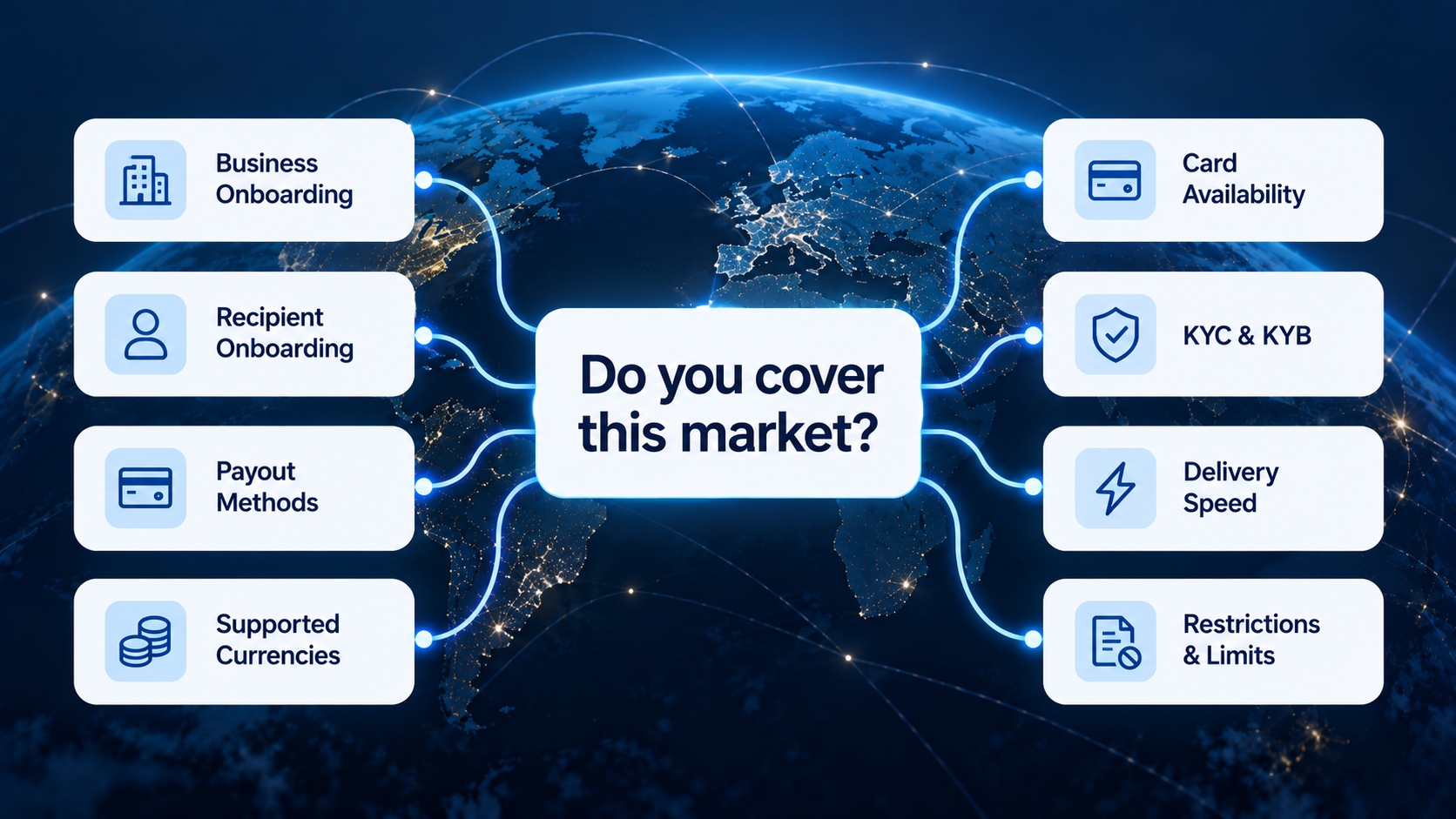
“Do you cover Germany?” is not one question. It is at least eight.
- Can you onboard the business there?
- Can you onboard the recipient there?
- Which payout methods are available?
- Which currencies?
- Can a card be issued there?
- What KYB and KYC requirements apply?
- How quickly do funds arrive?
- Are there recipient or transaction restrictions?
One provider in the studied set publishes a per-country matrix that makes this concrete. In one market, payments are available by wire in local currency but only to companies, with no local bank transfer option and no digital wallet. In another, local transfers are capped at a fixed amount and unavailable to entities based in that same country. In two others, availability depends on where the paying company is domiciled.
So at a single provider, “do you cover this market” has different answers depending on method, currency, payee type, and the payer’s own location.
An assistant compresses all of that into one response. The compression is the problem, and the output doesn’t show it. A confident answer can still hide the qualifiers a buyer actually needs.
Why Documentation Decides the Answer
One provider in the set publishes almost no capability data on its marketing site. No country count, no currency list, no payout methods named. It also publishes, on a separate developer documentation domain, the most detailed per-country availability table of any vendor we examined: supported destinations by region, which methods work where, local-currency deposits versus international wires, and explicit blanks for sanctioned markets.
That vendor scored lower than others on visibility in the first study. The second study answered questions about it more completely and with better sourcing.
In other cases, the most specific answer available came from somewhere the vendor does not control. A customer’s help documentation. A trade publication. An announcement archive. When a vendor has not published an operational detail directly, assistants find it wherever it exists, and the age and reliability of that source becomes the buyer’s problem.
Visibility and answerability are not the same problem. Getting named in a shortlist and being described accurately once named require different work.
A Note on Our Own Method
During validation, we revised our source-of-truth assessment four times after finding relevant first-party information outside the vendor pages we initially reviewed.
We had deliberately collected primary sources with a documented protocol. We still missed material on separate product pages, developer documentation, archived announcements, and customer help sites.
That is worth stating plainly, because the researcher’s problem and the buyer’s problem are the same. A buyer reviewing only a few product pages may never see the full picture.
Questions to Ask After the AI Builds Your Shortlist
About the AI answer itself:
- Why were these vendors included?
- What primary sources support those recommendations?
- Which credible providers may be absent?
- Is this drawn from current documentation or from older announcements?
About the vendors:
- What exactly does coverage mean in this market?
- Which payout methods are actually available there, and in which currency?
- Which capabilities vary by country or territory?
- What does recipient onboarding require?
- Which compliance functions does the platform handle, and which do we handle?
- Which claims are contractual, and which are generally available?
- Is this capability platform-wide or specific to one product?
- What happens when the preferred payout method is unavailable?
That list is deliberately demanding. It is the list we would want a buyer to bring to us.
Why Orchestration Changes the Coverage Question
Coverage is not simply the number of countries on a map. It depends on the combination of payout rails, recipient requirements, currencies, compliance processes, and delivery methods available for a particular use case.
That is also why payouts orchestration matters. It coordinates those variables across markets rather than treating geographic reach as a single yes-or-no capability. PayQuicker is a modern payouts orchestration platform available in 210+ countries and territories.
It is also why the documentation problem matters. A platform whose capability varies by market, method, and product needs to publish that structure, not just a headline number. That is a data architecture question before it is a marketing one, and this category has not solved it.
Because when a buyer asks, “Do you cover this market?” the useful answer is not a number.
The useful answer is: here is exactly what we can support, for whom, through which payout methods, in which currencies, under which requirements.
That is the standard payout buyers should expect from vendors, and the standard vendors need to meet if they want AI assistants to represent them accurately.
FAQ
Does a higher country count mean better coverage?
Not necessarily. A country count is only a starting point. It does not tell a buyer which payout methods, currencies, recipient types, limits, or compliance conditions apply in a specific market.
Should I trust an AI assistant’s answer about a payout vendor?
Treat it as a starting point rather than a verified fact. In our testing, the assistants were accurate most of the time, and the errors that did occur were details attached to otherwise correct answers, which is harder to catch than an obviously wrong headline.
Why would two assistants give different answers about the same company?
Most often because the information exists in multiple forms. Product pages, press releases, and documentation sites can carry different figures or describe scope differently, and each assistant may retrieve a different one.
Verify Before You Shortlist

The evaluation layer has moved somewhere vendors cannot see, and buyers are making real decisions inside it. The practical response is not to distrust the tools. It is to ask vendors market-level questions, and to expect market-level answers.
Explore our solutions to see how payouts orchestration handles market-level coverage, or talk to our team about the markets that matter to your program.
This article’s findings draw on original research covering 50 fintech and payments companies across eight categories, plus a supplementary accuracy study of 32 assistant responses conducted in October 2026. Payout providers other than PayQuicker are not named individually. Full per-company results are published in the DIGI CONVO Fintech AI Visibility Benchmark.